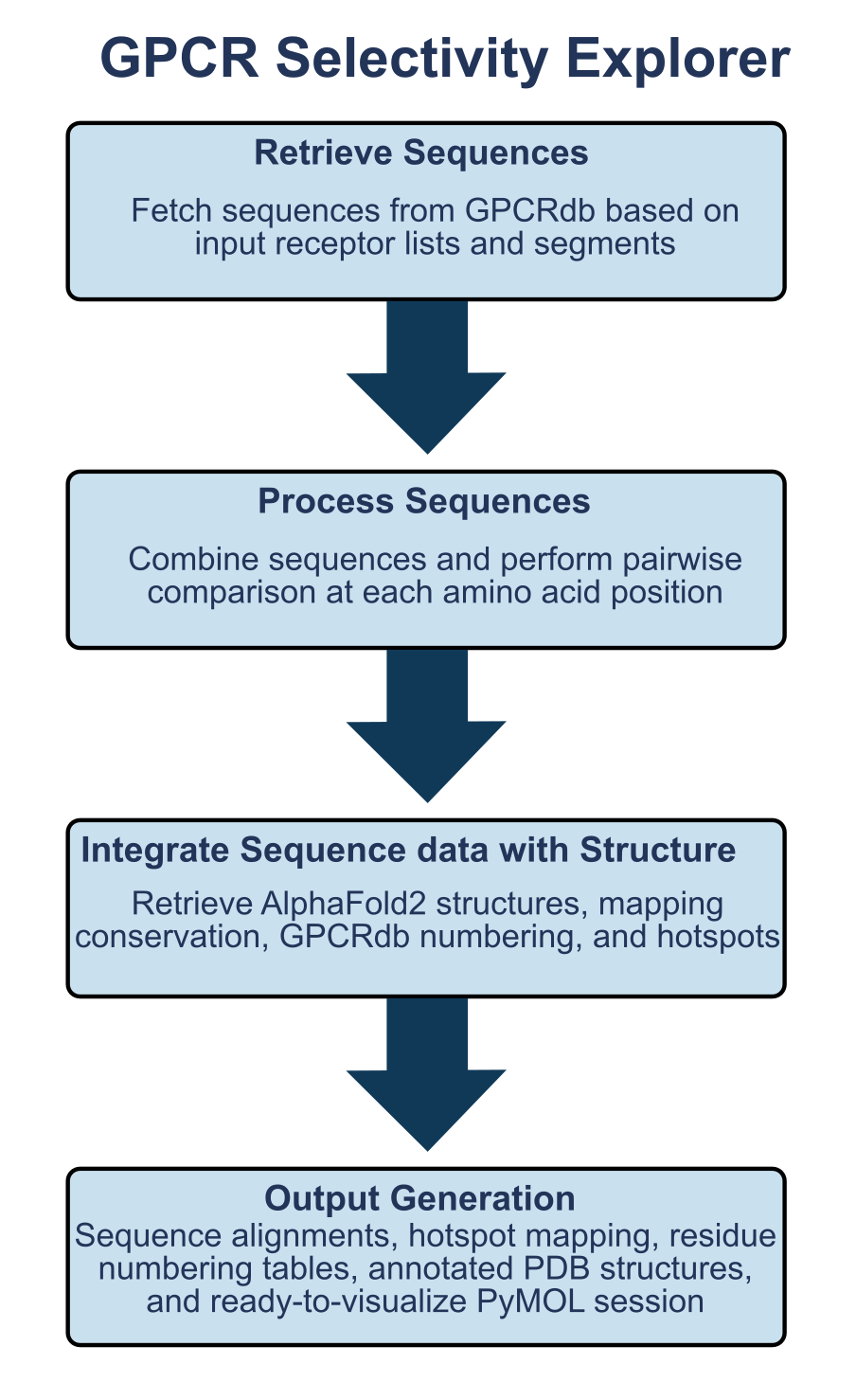
The GPCR Selectivity Explorer workflow begins by retrieving sequences for available species from GPCRdb based on the user's receptor lists and selected segments. A pairwise comparison of consensus amino acid positions is then carried out using the selected substitution matrix (e.g., BLOSUM62). Next, the structures of the selected reference receptors are fetched from the AlphaFold2 database and the selectivity hotspots, conservation values, and GPCRdb numbering are mapped onto the structures. Finally, users can download Excel files for alignments and residue tables, annotated PDB structures, and a ready-to-use PyMOL session for visualization.
INPUTS
Receptor(s) List A: Space-separated list of receptors uniport names (e.g., adrb1_human adrb2_human).
Reference Receptor A: Single receptor from the list to act as a reference (e.g., adrb2_human).
Receptor(s) List B: Space-separated list of receptors uniport names (e.g., drd1_human drd5_human).
Reference Receptor B: Single reference receptor from the list (e.g., drd1_human).
Segments: Select segments like TM1, TM2, ECL2 to focus the analysis.
Conservation Cutoff: Set threshold for sequence conservation (default: 80).
Substitution Matrix: Choose from the methods BLOSUM45, BLOSUM50, BLOSUM62, BLOSUM80, and BLOSUM90 (default: BLOSUM62).
NOTE:Residue substitutions are evaluated using BLOSUM matrix scores and classified as either conservative or non-conservative, where non-conservative substitution may influence receptor properties such as ligand recognition and activation. For example: a conservative substitution is arginine to lysine, while a non-conservative substitution is tryptophan to glycine.
OUTPUTS
Sequence alignments, mutagenesis files, and residue numbering tables are provided in Excel format (.xlsx).
3D receptor structures are delivered as PDB files (.pdb), along with a ready-to-use PyMOL visualization session (.pse). The PDB files include additional annotations encoded in the B-factor field:
GPCRdb numbering is stored in the B-factor field of the C atoms in the backbone.
Consensus conservation values are stored in the B-factor field of the N atoms in the backbone.
BLOSUM-based substitution classification is encoded in the B-factor field of the Cα atoms in the backbone using the following scheme:
Conservative substitution, above conservation cutoff in one receptor → B-factor = 12.5 (cyan in PyMOL)
Conservative substitution, above conservation cutoff in both receptors → B-factor = 25 (dark blue in PyMOL)
Non-conservative substitution, above conservation cutoff in one receptor → B-factor = 50 (orange in PyMOL)
Non-conservative substitution, above conservation cutoff in both receptors → B-factor = 100 (red in PyMOL)